Rules as Executed
When machine-executable laws are published
Anne Schuth and Eelco Hotting
Dutch Digital Service, Ministry of Economic Affairs and Climate
Spotlight tutorial at JURIX 2026, Toulouse
8 December 2026, 90 minutes. Time and room follow once the program is out.
Run the rule yourself
Somewhere in a government system, a rule decides whether you get a benefit, a permit or a fine. The statute behind it is published. The rule is not: it lives in databases, spreadsheets and bespoke software. No branch of government sees it whole. Parliament cannot see what its laws do in operation, and a court reviews decisions whose logic it cannot inspect.
Our position paper proposes to publish that rule as a machine-executable specification: an interpretation of the statute, article by article, in a format built to be read by legal professionals. The organization decides cases with the specification it publishes, so whoever receives a decision can run the rule again and check the outcome.
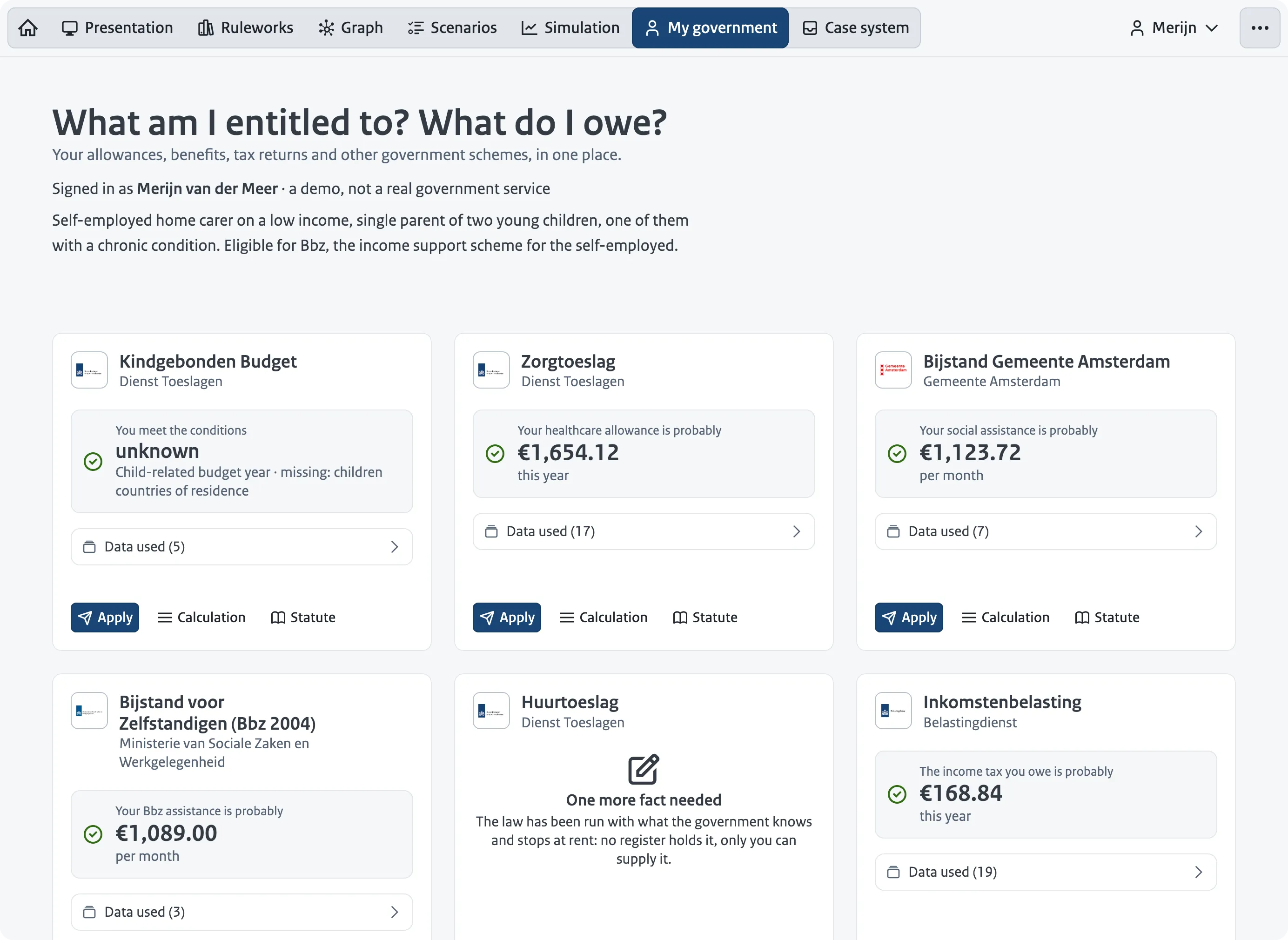
RegelRecht is the reference implementation. In ninety minutes we open real Dutch statutes next to their specification, change a threshold and watch who loses an allowance. Then we follow one application from the citizen's screen to the case worker's desk.
Open the demo on your own laptop and try to break it. We expect to be argued with, and we have left room for it.
Program
We follow the tabs of the demo and take the discussion as it comes. Timings are indicative: where the room wants to stop is where we stop.
- The problem (10 min). Why the rule as executed must be independently verifiable, and why today no branch of government sees it whole.
- Laws (20 min). A statute and its specification, article by article. Then the graph: an allowance that depends on being insured, which depends on whether you are detained.
- Scenarios (10 min). "Someone under 18 gets no allowance", written as a sentence and run as a test. Change the law and see which sentences stop being true.
- Simulation (5 min). A generated population through the same laws. Turn a threshold and count who falls out, before the amendment is passed.
- Citizen and entrepreneur (10 min). Merijn, single parent and self-employed, sees what he is entitled to, each figure traceable to its source, and is asked only what no register knows. Claudia wants a terrace in front of her coffee shop and meets three authorities in one view.
- Case system (10 min). The other side of the counter: the engine recomputes what the citizen saw. Where the law gives the power, the case worker departs from the outcome, and the ground is recorded.
- The same article, four ways (15 min). One article in our YAML, in Catala, as an OpenFisca-style formula and as LegalRuleML. Come and tell us why we should have used yours.
- Closing (10 min). What is built, what is not, and the questions we cannot answer without this room.
Who it is for
For people who formalize law, and for people who worry about what that does to it. There are no prerequisites and there is no programming. Bring a laptop or phone, and your objections.
Materials
We present from the demo itself, slides included, so everything shown in the room is already open to you. To prepare, read the introduction and Section 4 of the position paper (doi:10.5281/zenodo.22201094).
- The demo, nothing to install
- The documentation
- The design RFCs
- The source code, under EUPL-1.2
Organizers
Anne Schuth is the technical lead of RegelRecht at the Dutch Digital Service. He holds a PhD in information retrieval and worked at Google, Microsoft Research and Spotify.
Eelco Hotting is a strategic adviser at the Dutch Digital Service and co-author of the position paper.
Questions about the tutorial: anne.schuth@rijksoverheid.nl.
RegelRecht
An exploration into transparent, executable legislation, and one of the three projects in the starting selection of the Nederlandse Digitale Dienst.
Links
GitHub repository
How it works
Stay informed
Roadmap (Dutch)
Documentation
Research
Contact
Part of
Nederlandse Digitale Dienst
Ministry of Economic Affairs and Climate Policy